
Grieving the Crown Jewel
And planning for the future

“New beginnings are often disguised as painful endings.”
~ Unknown, though frequently attributed to Lao Tzu
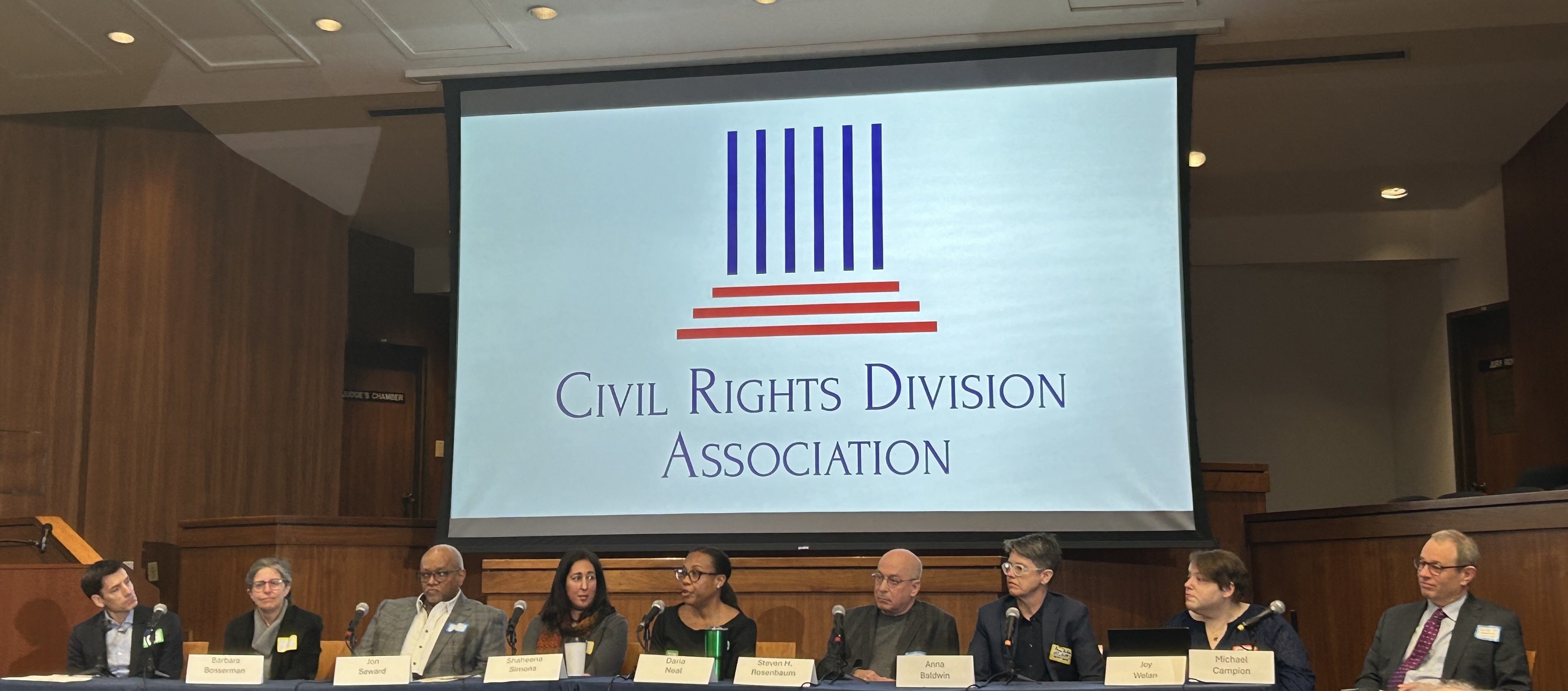
I had the great fortune over the weekend to attend a conference hosted by the Civil Rights Division Association (CRDA). The CRDA is a non-partisan organization for current and former employees of the Civil Rights Division, as well as current and former DOJ employees who worked on Division issues. The conference focused on the Civil Rights Division in the 21st Century, looking back on the Division’s achievements over the previous decades, taking stock of the current state of the Division, and looking to the future.
There were some very big voices in the room! Former heads of the Civil Rights Division like Kristen Clarke, Vanita Gupta, and Tom Perez (who later served as the Secretary of Labor under President Obama) were present, as well as numerous other former high-ranking attorneys, prior section chiefs, and incredibly skilled and accomplished lawyers and staff.
For me, it was bittersweet and conjured up a variety of memories and feelings. When I applied to the Division during the summer of 2023, I didn’t believe I would get it and for good reason – I had applied for a nearly identical position two years prior and didn’t get an interview. Plus, while I checked some of the boxes typically desired by employers – graduating in the top 10% of my law school class, writing for and holding a leadership position with the Law Review, completing a judicial clerkship following law school, and possessing a wealth of experience – I didn’t believe I fit the profile of the “traditional” candidate: I attended a public law school rather than an Ivy League or top-25 law school; I completed a state court clerkship rather than a more prestigious federal court clerkship; I was from the middle of nowhere in rural, Ohio and had spent the vast majority of my career in the state; and, I was in my mid-forties. How could I compete?
I wasn’t applying for some run of the mill position, either. This was for a job at the Civil Rights Division of the U.S. Department of Justice, which at that time was the most storied Division in one of the most prestigious, elite, and powerful institutions in our nation’s history. In my graduate work studying social movements and during law school, I had studied the pivotal figures and cases emanating from the Division.
Even the origin story of the Division is momentous. The DOJ itself was created in 1870 to handle post-Civil War and Reconstruction litigation. The promises of Reconstruction went unfulfilled, however, and the government’s efforts to mitigate the impacts of enslavement and racism went dormant. The century of Jim Crow that followed was marked by segregation and rampant violence against Black Americans, especially in the South. Along with the continued rise of the KKK, Black Americans experienced widescale deprivation of their rights, especially the right to vote.
In the absence of government action, however, the work to achieve racial equality didn’t stop. Instead, it shifted to the people and civil society organizations. After the successful execution of the strategy that led to the Brown v. Board of Education decision in 1954 desegregating schools and the subsequent refusal by some state and local governments to follow its mandate, the federal government finally took an active role. The Civil Rights Act of 1957 established the Civil Rights Division, making it a separate, standalone division with an additional appointed Assistant Attorney General to lead it.
Following the successes of the Civil Rights Movement in abolishing segregation, the Civil Rights Division’s enforcement responsibilities were expanded under subsequent civil rights legislation. Several acts were passed for the explicit purpose of combatting racial discrimination against Black Americans, including the Civil Rights Acts of 1960 and 1964, the Voting Rights Act of 1965, and the Fair Housing Act of 1968. Thus, the inception of the Civil Rights Division was directly tied to advancing the civil rights of Black Americans in recognition of the fact that, since the end of Reconstruction, their rights, especially the right to vote, had been systematically stripped from them. The Division’s work came to include the enforcement of civil and constitutional rights for all Americans, particularly marginalized groups.
It is precisely because of the Division’s critical, historical role in protecting our core constitutional rights and upholding our nation’s commitment to equality and fundamental fairness that it is referred to as the “crown jewel” of the DOJ. As former Associate Attorney General and Acting Assistant Attorney General for Civil Rights, Vanita Gupta, poignantly remarked during the event, “the Civil Rights Division is where the highest ideals of this country meet its hardest truths.”
It’s easy to see why, then, it felt surreal from the moment in October 2023 when I first got contacted by the DOJ for an interview, to the moment I moved to Washington, D.C., in February 2024 to join the Disability Rights Section. For the first 6 months of my time with the Division, I fluctuated between feelings of pride and belonging to the belief that they would realize they’d made a mistake and fire me! As I began to settle in, though, I mostly felt humbled and blessed. I was surrounded by the most brilliant, collaborative, intellectually rigorous, and supportive colleagues of my career. It was sheer excellence. Because of that, I became a better attorney and a better person. And I had no intention of squandering that opportunity or taking it for granted.
So, after everything that’s happened at the DOJ over the last year, it was wonderful on Saturday to be surrounded by my former colleagues and converse with people I’d never gotten the chance to know when I was at DOJ but whose work I admired. But it was also a painful reminder of what I had lost and, more importantly, what the country has lost.
The status of the Division today is grim. A mass exodus of staff occurred in the wake of both the deliberate pressure placed upon us to leave and the upending of our core missions. The Division has gone from 375 attorneys at the beginning of this administration, many of whom had previously served during both Democratic and Republican administrations, to 90 in the year since Donald’s inauguration. That’s a 75% decrease of dedicated civil servants representing an enormous loss of expertise and institutional knowledge.
Unsurprisingly, the impact has been significant. Over 45 court cases and multiple consent decrees that were ongoing at the time of the change in administration have been dismissed, withdrawn, or otherwise closed down. As we know, investigations that should have been routine, such as the killing of Renee Good by an ICE agent in Minneapolis, were never initiated. There’s been a stark reduction in the number of new cases and enforcement actions. For example, enforcement of the Americans with Disabilities Act (ADA) was down 85% between the last year of the Biden administration and the end of the first year of the Trump administration. Tens of millions of Americans have or will be adversely affected in areas like housing, voting, environmental justice, employment, and education. As I noted in my “No Kings” post several days ago, the Civil Rights Division no longer exists as we knew it.
We must celebrate its accomplishments, grieve its demise, and let it go because, as history tells us, this is not the end. We’ve entered another period in which the federal government is abandoning its responsibilities to advance the cause of equality. The work has never, and will never, stop – but the bulk of it falls, once again, to the people. In this phase of our nation’s struggle for human rights and equality for all Americans, however, the federal government hasn’t simply become dormant; it is actively seeking to undermine and reverse the progress made since the Civil Rights Division was established.
This time around, though, there’s a cadre of dedicated, seasoned former Division attorneys with unparalleled expertise joining the side of the talented people and civil society organizations bearing the burden. There are countless folks stepping up to use their voices in multiple ways: through people working in private firms, non-profits and non-governmental agencies, as well as in state and local governmental agencies pushing back against federal overreach and abuses; by researching and drafting court opinions on behalf of judges upholding the Constitution and the rule of law; through teaching students and educating the public; by speaking out via writing and interviews; and, by those who have remained at the Division to continue the work the best they can. These brave and brilliant folks are not backing down.
By the day’s end, I found myself comforted and fortified by both the echoes of history and the beckoning of future possibilities. It was not lost on me that the event was held at Howard University’s Law School, where legal giants of the Civil Rights Movement, like Thurgood Marshall, Pauli Murray (a personal favorite of mine), and so many others had walked. While the “crown jewel” of the DOJ is no longer, its legacy is not and never will be erased. The best parts of it can and will be incorporated into, strengthened, and reimagined during the forthcoming rebuilding. And that bolsters my resolve to be part of that vitally necessary work.
One step at a time,
Ronda
Heartening to read about the brilliance, resolve, and forward thinking of those who were formerly in the Civil Rights Division- as elsewhere.
This may be the greatest tragedy of the MAGA/Heritage administration. I am so glad and grateful you and your former co-workers are continuing the fight even without the scaffolding of the institution.