
dēmokratia
What is "democracy," really? It's what we demand it - and ourselves - to be.

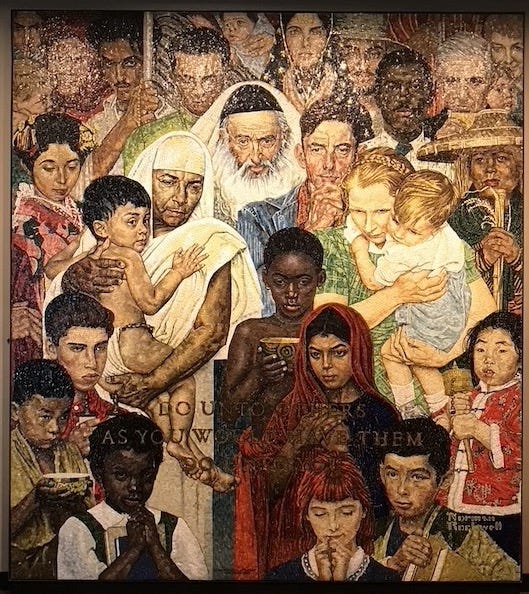
In December 2022, I traveled from Ohio to Manhattan to attend a political fundraiser and stayed for five days on a mini-vacation. I explored the city, engaging in a few of the quintessential New York City activities like going to museums and art galleries, and meeting friends for coffee. One afternoon, I did something I had long wanted to do but, embarrassingly, never had — I took a tour of the United Nations (U.N.) Headquarters.
I learned about the workings of the U.N., sat in some of the rooms where global decisions are made, like the U.N. General Assembly Hall, and saw the many pieces of artwork and sculptures donated by various nations interspersed throughout. On the third floor hangs the beautiful mosaic pictured above, titled The Golden Rule, which is based on a Norman Rockwell painting by the same name. It depicts women and men, adults and children, of different nationalities, races, and religions in a state of harmony and unity. The mosaic is inscribed with the phrase “Do Unto Others as You Would Have Them Do Unto You” and symbolizes human rights and dignity of all peoples.
It was, in some ways, a full circle moment for me. A decade before, I was living in the U.K. undertaking an LL.M. (Master of Laws) degree in International Human Rights Law at the University of Essex. It was one of the most incredible years of my life. I learned from top-notch international lawyers who were not only brilliant academics, but also prestigious practitioners in the fields of international human rights and humanitarian (i.e., the laws of war) law.
My favorite aspect of the program, however, were my fellow classmates. I met and heard fascinating stories of people from all over the world: Armenia, Australia, Azerbaijan, Brazil, Cambodia, Colombia, France, Georgia, Germany, India, Iran, Italy, Mexico, Nepal, Norway, Palestine, Romania, Spain, Thailand, Syria, the U.K., the U.S., Uzbekistan, and more.
The cohort included Muslims, Jews, Hindus, Christians, Buddhists, and atheists; women and men; gay and straight; every race. All converging to gain an in-depth knowledge of human rights principles and laws.
The establishment of the United Nations and its foundational documents — the U.N. Charter, the Universal Declaration of Human Rights (UDHR), and the International Covenants on Economic, Social, and Cultural Rights and on Civil and Political Rights — were the cornerstone of our studies. They were groundbreaking.
For the first time, the notion of universal human rights — that every human being on the planet has inherent rights simply by existing — rather than rights based on status, wealth, ascribed characteristics, or some other category, was recognized and, more importantly, formalized.
The United Nations and these legal instruments weren’t established in a vacuum. They were derived in the wake of the atrocities of World War II. Germany’s unprovoked war of aggression against several nations — and its genocide against its own and those nations’ Jewish populations and other minorities — generated such wide-spread destruction, depravity, and shock that it sparked recognition of the need for robust international cooperation, security, and protection of human rights. Up to that point, the world had operated under the notion that a nation has complete sovereignty over how it treats its citizens, free from interference or intervention from other nations.
It may seem implausible that universal human rights were first formalized on a global scale with the adoption of the UDHR in 1948 given that democracy — widely recognized as the best system of governance to achieve human rights — dates back to the time of the ancient Greeks. According to the encyclopedia Brittanica, “democracy” comes from the Greek “dēmokratia” — literally, the people (“demos”) rule (“kratos”).
Of course, which people get to rule in a democracy has shifted over time, with minority groups and persons of lower socioeconomic status frequently excluded. In the U.S., the only people permitted in the democratic process initially were white, propertied men. Women, persons of color, the LGBTQ+ community, and persons with disabilities fought hard, enduring discrimination, oppression, and, in some cases, unconscionable brutality in order to expand democracy and attain civil rights protections.
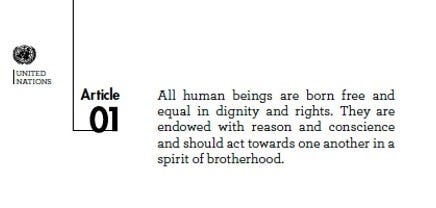
Part of the reason we have come to this critical moment in our history is that too many misapprehend the meaning of democracy—it is not an endpoint or simply about voting (as important as voting is). Democracy is a process, something that requires attention, work, and vigilance. In his book On Freedom, Timothy Snyder discusses the need to shift from a mentality of “freedom from” impingement of rights by the government, to a more robust “freedom to” thrive in collaboration with others. Interestingly, though perhaps unsurprisingly in this “me and mine” culture, most people focus on the first sentence of Article 1 of the UDHR rather than the second, especially how human beings “should act towards one another in a spirit of brotherhood.”
Similarly, Jeremy David Engels asserts in his book, On Mindful Democracy, A Declaration of Interdependence to Mend a Fractured World, that democracy “is a practice of mutual care” and that no one is more worthy, important, or deserving of having more respect, safety, or rights than others. We recently touched on this during my Big Voice Wednesday conversation with law professor Tara Van Ho: to ensure that your rights are recognized and protected, you have to accept that that applies to others who have the same rights and same protections. A failure or refusal to recognize one person’s or group’s rights jeopardizes the rights of all of us.
This shift in perspective would result in a more robust, interdependent, fully inclusive democracy and constitute a vitally necessary counterbalance to the global autocratic movements of selfishness, greed, and corruption which, as they spread, reveal themselves to be unstable, corrosive, and destructive – antithetical to the kind of governance we have ostensibly aspired to in this country and in democracies since the end of WWII. A more inclusive democracy, one that recognizes the inherent equality and interconnectedness of all human beings, is the most powerful corrective to the failure to recognize any individual or group’s right to equality.
I take comfort in knowing that, all over the world, individuals, communities, and organizations have long been, and are continuing, to pursue this vision of democracy and universal human rights. Many of my colleagues from the LL.M. program are doing incredible work for human rights and equality.
Fostering this transformation begins with each of us and the choices we make. To me, when we do something for others — be it people, animals, or the planet — not only is it an exercise of democracy, but it also strengthens democracy because it is, in part, a recognition that we must share our world with others and that helping others in turn helps us. As Snyder states in On Freedom, democracy “does not arise on its own. [It] is a verb disguised as a noun. Its supporters must believe in it and improve it.”
So, what kind of democracy do you choose to have? What action, no matter how small, can you take each day to brighten your part of the world and make it better for other living beings? Grand gestures are not required. You can donate food, money, or clothing; volunteer to walk dogs at local shelters; pick up trash in local parks or neighborhoods; post information on social media; or, buy a stranger a cup of coffee. And, of course, continuing to engage in “traditional” civic duties like voting, volunteering to be a poll worker, contacting legislators, campaigning, writing postcards, etc., are indispensable towards fulfilling the goal of human rights for all. Sometimes, the best we can do is get out of bed or not allow ourselves to get lost in doom scrolling or feelings of hopelessness. The possibilities are endless.
In the midst of the current chaos, destruction, and upheaval, I hope we seize this opportunity to reimagine what it means to live in a democracy and that we move away from an individualistic, abstract concept towards an inclusive, vibrant, and interconnected democracy that’s an indelible part of our everyday lives.
Do democracy.
Be democracy.
One step at a time,
Ronda
A great post and wonderful artwork, thank you, from Snowdonia National Park, north Wales, UK. Long live internationalism and human rights
What a perfect statement of what is important in life & civic duty. I always say everything you do that helps people or animals, no matter how small, makes the world a better place. I always vote, used to volunteer at food banks, adopt animals, donate to my local humane society, help friends & others. When I can I donate to good charities, Save the Elephants & Planet Wild. Would donate to more, but financial responsibility is also important.