
Big Voice Wednesday
With Ruth Ben-Ghiat

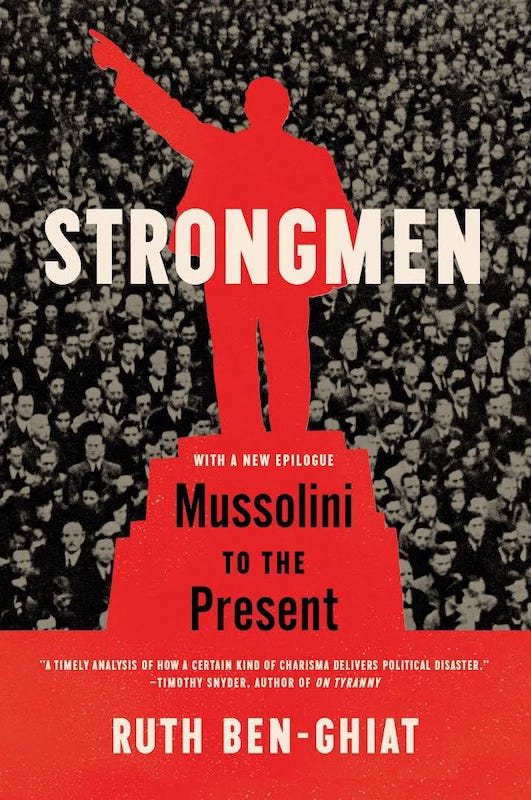
I was privileged to welcome our friend Ruth Ben-Ghiat for this week’s Big Voice Wednesday discussion. Ruth is an NYU professor, historian, and expert in authoritarianism. Her New York Times bestselling book, Strongmen: Mussolini to the Present, and her Substack newsletter, Lucid, are indispensable reading for the times we’re living in. Ruth helps us to understand what is happening and to identify the authoritarian patterns and tactics being used to undermine democracy here and abroad. She does so with a level of clarity and insight that is vital to our ability to prepare for and resist authoritarianism.
Ruth’s path to studying authoritarianism is fascinating. When events resembling what she’d been researching and writing about during her career began to unfold in the U.S., she didn’t hesitate to use her knowledge and voice to identify it and speak out against it. We are lucky to have her to help us navigate this tumultuous time in our history. Her wisdom and parting words on what gives her hope are inspiring.
The transcript of the interview is below, edited for clarity, length, and flow.
Always remember that the smallest action can have a BIG impact!
One step at a time,
Ronda
[Transcript]
Ronda Cress: Hello everyone, and welcome back to Big Voice Wednesday. Big Voice Wednesday aims to break up the unrelenting news cycle in the middle of your week and hopefully inject some inspiration and hope—sometimes even a little humor—to help get you through the rest of the week. And boy do we need it this week.
Big Voice Wednesday showcases ordinary individuals who I think are doing extraordinary things using their voices in extraordinary ways, and sometimes even in unexpected ways. I’m very excited to have as my guest this week an NYU professor, a historian, and an expert in authoritarianism. She’s the author of the New York Times bestselling book Strongmen: Mussolini to the Present and the Substack newsletter Lucid, both of which I believe are required reading, especially during this moment in our history. And I’m also very privileged to be able to call her a friend.
So please welcome Ruth Ben-Ghiat.
Ruth Ben-Ghiat: Hi, it’s really good [to see you].
Ronda Cress: Hey Ruth. It’s so nice to have you here. I know your time and your expertise are in high demand, so I really appreciate you taking the time to talk with us.
One of the reasons I wanted to have you here is because of your research and work on authoritarianism. I find it not only very informative, but also very comforting to be able to read your work, because it helps us make sense of things and couch them in terms of identifying patterns and tactics. We can see things that are happening and recognize that they’re right out of the authoritarian playbook.
Sometimes I get a little frustrated when I hear people say, “Oh, he’s just a madman and this is crazy and there’s no reason and it doesn’t make any sense.” I want to scream, “Well, go read Ruth’s work,” because it does make sense and it’s all very deliberate.
So I wanted to ask you right off the bat—obviously the most pressing topic now is the war with Iran. I wanted to ask how you see that fitting into the authoritarian playbook, or if it fits into the playbook.
Ruth Ben-Ghiat: Unfortunately, it fits in well—meaning there’s nothing good about it, and it aligns with what other leaders have done.
I had written an op-ed for the New York Times on February 1st about autocratic backfire. We’ll get to a hopeful part of that, but the idea is that when leaders get into this process of being in a bubble—starting with their narcissistic megalomania—they create structures often called the inner sanctum or the clique. They surround themselves with sycophants, cronies from the old days, or family members, and they cleanse institutions of anyone who might tell them no.
As a result, they’re not really listening to experts and they’re not getting objective empirical feedback. This is also why authoritarians always go after the same groups who deal with facts: prosecutors, members of the judiciary, journalists, academics—people who deal with truth.
They get into this bubble and start to believe their own propaganda, that they’re infallible. So they begin implementing policies that can be very personal and idiosyncratic, and that are often poorly received by the public—especially economic policies.
Here’s the key point: when they start doing things that create major public discontent, instead of retracting and correcting course, they double down. When they feel threatened, they become more aggressive. This is when, as I wrote in my piece, they sometimes go to war.
Putin was in this situation right before he invaded Ukraine. So here we are with a war that was not even presented to the public with a coherent narrative justification. Senator Whitehouse even said it could be a war to distract us from the Epstein files, for God’s sake.
We are in the middle of this tragic pattern that happens when autocrats feel threatened and want to make their mark on history.
Ronda Cress: Does that also signal some desperation, though? Is it a sign that scrutiny, criticism, and dropping poll numbers are having an impact?
It seems perverse—the more scrutiny he faces, the more his logic is ripped apart, and the response is to start a war. But is that one possible takeaway?
Ruth Ben-Ghiat: Yes. They do get more desperate when they feel under scrutiny. It’s also a sign that they haven’t succeeded in fully reshaping the state to eliminate threats.
But there is never a point at which such rulers stop feeling threatened. Putin was already far beyond where we are now in terms of consolidating power, yet he still felt he needed to invade Ukraine because he was becoming unpopular with young people and the economy was struggling after the pandemic.
So, he went into Ukraine claiming he would revive the mythical Russian empire. We can apply similar logic to Netanyahu. Like Trump, he came to power while under investigation and has tried repeatedly to shut down the judiciary to stop corruption investigations.
Netanyahu also faces an International Criminal Court arrest warrant and has pursued a messianic extremist policy in Gaza.
Once leaders enter a war, they often need to prolong it. They don’t prioritize human life beyond their own power. War allows them to postpone elections, claim emergency powers, and consolidate authority.
This process is extremely dangerous and tragic. But the reason it’s called “autocratic backfire” is that, eventually, these wars can contribute to the downfall of the leaders who start them.
Ronda Cress: Sure. They can’t possibly control every variable.
You mentioned Putin and Netanyahu. I listened to your discussion last week with Anne Applebaum, which was incredibly informative. You touched on something briefly that I’d love to explore more.
We seem to be witnessing a global authoritarian movement. Authoritarian leaders have always existed, but it feels like it’s emerging more widely now, including in powerful countries like the United States.
It also seems like there’s increasing cooperation between these leaders. That’s interesting and a bit surprising because they’re all narcissists who prioritize their own interests. I assume they would turn on each other when it suits them.
What do you make of this global coordination?
Ruth Ben-Ghiat: There are a couple of things to say.
First, they may be working together more because individually many of them are weaker. Russia, for example, is essentially a failed state now. Something people don’t hear enough about is that China is propping up Russia economically in a very significant way.
At the beginning of the Ukraine war, many people were surprised by Russia’s military failures. But if you study institutions and kleptocracy, it makes sense. The Russian military had been hollowed out by corruption.
The war has reduced Russia’s autonomy. Russia now has fighters from 12 nations involved—not just North Koreans.
China is increasingly in control. Historian Stephen Kotkin recently described Russia as a vassal state of China.
Since January, I’ve said that Trump is in office to solve Putin’s problems. Russia is a failing state, and Trump has appointed individuals—like Tulsi Gabbard and others—who appear positioned to assist Putin’s interests.
The other element is that Trump seems to be creating alternate international structures. One example is the so-called “board of peace.” Another is the “Shield of the Americas.”
Putin’s major problem is that Russia became a global pariah after being removed from institutions like the G8. Trump seems to be building alternate institutions to replace democratic international frameworks.
They reject NATO, the United Nations, and the system of democratic international law. These frameworks promote human rights, international justice, and accountability.
Trump’s closest allies—Putin and Netanyahu—both have international arrest warrants. So undermining the credibility of international law serves their interests.
This is why we see attempts to discredit democratic internationalism itself. Autocratic regimes want freedom from international scrutiny for actions like repression, corruption, and violence.
Ronda Cress: It’s such a transparent attempt to dismantle the entire post-World War II order that was designed to prevent something like World War II from happening again.
It’s disturbing. Even if they succeeded, I don’t see it creating stability or peace. I imagine it would only lead to further instability.
And I agree with you about Putin. It often feels like all roads lead back to him when it comes to Donald. Sometimes I want to shout when people express surprise that Donald repeats Putin’s talking points.
It shouldn’t be surprising anymore.
Ruth Ben-Ghiat: Exactly. It’s hugely frustrating. There has been ample evidence for a very long time, starting with election interference and everything surrounding that.
That’s why he works so hard to call it the “Russia hoax.”
I even analyzed the Helsinki Summit body language between Trump and Putin in 2018 for CNN. Trump’s body language around Putin was incredibly submissive.
The evidence has been there for years. Now it’s simply more visible. But many people still don’t want to accept that America has effectively changed sides.
Ronda Cress: Right.
I’d like to shift slightly. One goal of my newsletter, The Little Girl with the Big Voice, is to encourage people to find and use their voices to improve their communities and democracy.
You are clearly using your voice in powerful ways. But what originally inspired you to do this work? I can’t quite imagine Ruth as a little girl saying she wanted to become an expert on authoritarianism.
Ruth Ben-Ghiat: No, I didn’t grow up with that goal.
My mother is from Scotland, from a Protestant working-class family. My father was born in Jerusalem, from a Middle Eastern family—his father was from Yemen and his mother from the West Bank of Palestine.
So my background was very global. We settled in Southern California.
Interestingly, I didn’t grow up hearing much about the Holocaust or dictatorships. But the town where I grew up, Pacific Palisades, was home to many intellectuals, musicians, and writers who had fled Nazi Germany.
In high school there were presentations about their experiences, and I started wondering what it meant for people to leave Berlin and their entire lives behind to settle in this small town by the Pacific.
Later, when I went to UCLA, I wrote my senior thesis about a conductor because I was a serious pianist. Arnold Schoenberg’s son taught at my high school, so I had personal connections to that history.
Eventually I chose to study fascist Italy rather than Germany in graduate school.
I also think my own family’s immigrant experience influenced me. To see relatives, we had to take long flights from Los Angeles to London or Tel Aviv.
When I was in high school, one neighbor’s family had fled communism in Czechoslovakia, and another neighbor was a Holocaust survivor who had been in Auschwitz.
So, I was surrounded by people who had survived fascism and communism. That made me think about these histories.
For many years I was simply an academic studying fascist Italy. But when Trump emerged and began using violent rhetoric, it felt familiar. I realized I had to warn people.
I started writing for CNN, which gave me a large global audience, and the work expanded from there.
Ronda Cress: That’s fascinating. And when you began speaking publicly more—doing interviews, appearing on television—what was that transition like?
Ruth Ben-Ghiat: It was very different. I had given conference talks and keynote speeches, but television was new for me.
Being from Los Angeles, where there are many actors and media professionals, I never imagined myself appearing on television.
But I eventually discovered that I enjoyed explaining complex ideas clearly and concisely. Television forces you to communicate efficiently. If you don’t, you have someone in your ear telling you to “wrap it up!”
What motivated me most was seeing that people found the explanations helpful. Even when the message wasn’t uplifting, it helped people see the patterns and logic behind events.
That encouraged me to devote more time to public education.
After January 6th, I started the Lucid Substack newsletter because I knew the stakes had become incredibly high. I wanted to expand civic education and create a space where people could ask questions.
Of course, there are unpleasant aspects—hate mail and harassment—but those are outweighed by the sense that the work helps people understand history and prepare for what may come.
Ronda Cress: We are all definitely better off because you chose to do that.
Before we wrap up, I’d love to ask one final question. What gives you hope right now? Do you have hope?
Ruth Ben-Ghiat: I do have hope.
Yes, authoritarian leaders are appearing in many places, but we are also living through a global moment of resistance against autocracy.
We see protests and grassroots movements around the world. When injustice and brutality reach people’s doorsteps, communities organize, build networks, and find courage.
That is happening in the United States as well.
And I always remind people: never underestimate the American people.
I believe we will get through this. Eventually the corruption and malfeasance will lead to consequences at the ballot box, and we may emerge as a stronger democracy because of what we have endured.
Ronda Cress: I completely agree, and that’s a great place to leave it.
Thank you so much for taking the time to be here and sharing both your expertise and your personal story. And thank you to all of the viewers for watching.
Always remember—even the smallest action can have a big impact.
We’ll see you again soon. Take care.
Ruth Ben-Ghiat: Thank you. Bye.
Ronda, This is the best interview with Ruth I have ever heard! (And she has been interviewed by the best of the best). You are deceptively deep.
I love listening to Dr. Ben-Ghiat! She is such an uplifting speaker. Globally, we have been here before and have emerged stronger for it. “The malfeasance will be the undoing of the Republican Party”! Absolutely! Thank you for your stellar interview.